FiledReading6 minViews13
The Rise of Ambient AI Scribes in Australian Hospitals: A 2026 Guide to Clinical Documentation
If you walk into any Australian hospital ward at 6:00 PM, you will likely see the same scene: junior medical officers (JMOs) and senior clinicians huddled around glowing screens, furiously typing. Fo
Table of contents8 sections
If you walk into any Australian hospital ward at 6:00 PM, you will likely see the same scene: junior medical officers (JMOs) and senior clinicians huddled around glowing screens, furiously typing.
For decades, the "clerical burden" has been the silent epidemic of the Australian healthcare system. According to recent workforce data from the Australian Medical Association (AMA) and the RACGP, Australian doctors spend an average of 15% to 25% of their working day on administrative tasks. Much of this bleeds into unpaid, after-hours work, a phenomenon universally dreaded as "pajama time."
But in 2026, the landscape of clinical documentation AI has fundamentally shifted. We are moving away from traditional transcription and dictation tools, entering the era of the ambient AI scribe.
For hospital executives, CMOs, and clinical informatics leads, understanding and implementing this technology is no longer optional—it is a critical lever for retaining clinical staff and ensuring patient safety.
Here is your definitive guide to how ambient AI is transforming Australian wards, why it works, and how it directly impacts clinical handovers.
What Exactly is an Ambient AI Scribe?
To understand the breakthrough, we have to distinguish ambient AI from the tools of the past.
For years, clinicians have used dictation software. While helpful, dictation requires the doctor to actively dictate punctuation ("comma," "new paragraph") and manually structure the note post-consultation. It is a highly active, disruptive process.
An ambient AI scribe, conversely, acts like a silent medical student in the room. Using advanced Natural Language Processing (NLP) and secure mobile microphones, the AI "listens" to the natural, unstructured conversation between a doctor and a patient—or between two clinicians during a ward round or shift handover.
It filters out the "small talk," identifies the clinical intent, and automatically structures the data into standard clinical formats, such as a SOAP note (Subjective, Objective, Assessment, Plan) or an ISBAR handover summary.
Why 2026 is the Tipping Point for Australian Hospitals
The adoption curve for ambient AI scribes in Australia has skyrocketed. This isn't just about cool technology; it’s a direct response to three compounding pressures in the Australian public and private health sectors.
1. Crushing "Pajama Time" and Reducing Doctor Burnout

Burnout is driving an exodus of highly skilled clinicians. The cognitive load of managing complex patients is heavy enough without the added burden of remembering every detail to document hours later.
By capturing conversations in real-time, ambient AI software drastically reduces this cognitive load. Early trial data across major Australian health networks shows that ambient documentation can save clinicians up to 2 hours per shift. By effectively eliminating "pajama time," hospitals are seeing direct improvements in self-reported JMO wellbeing and retention.
2. Bulletproof NSQHS Standard 6 Compliance
The Australian Commission on Safety and Quality in Health Care (ACSQHC) is uncompromising on NSQHS Standard 6: Communicating for Safety.
Manual handovers are notoriously prone to error. Crucial information is often lost between the spoken word and the written note. An AI handover software system standardizes this process. Because the AI captures the actual conversation, it ensures that nothing falls through the cracks, generating a comprehensive, time-stamped, and compliant ISBAR record automatically. This provides a measurable, auditable safety outcome for hospital accreditation.
3. The Data Sovereignty Mandate
Historically, Australian hospitals hesitated to adopt US-based AI tools due to strict local privacy laws. Under the Privacy Act 1988 and state-based health records legislation, clinical data must be handled with extreme care.
In 2026, leading platforms like Handovex are built specifically for the Australian context. This means:
- Local Data Hosting: Audio and transcripts are processed and stored on secure, Australian-based servers (e.g., IRAP-assessed cloud environments).
- Zero Retention Policies: Audio files are immediately deleted once the structured text is approved by the clinician.
- Local Nuance: The AI is trained on "Australianisms," easily understanding local drug names (e.g., Panadol vs. Tylenol) and clinical acronyms (e.g., MET calls, NUMs, RMOs).
How Ambient AI Transforms Clinical Handover
Clinical handover is widely recognized as the most dangerous period in a patient's journey. Relying on scribbled notes on paper "brains" or memory recall at the end of a chaotic 12-hour ED shift introduces massive clinical risk.
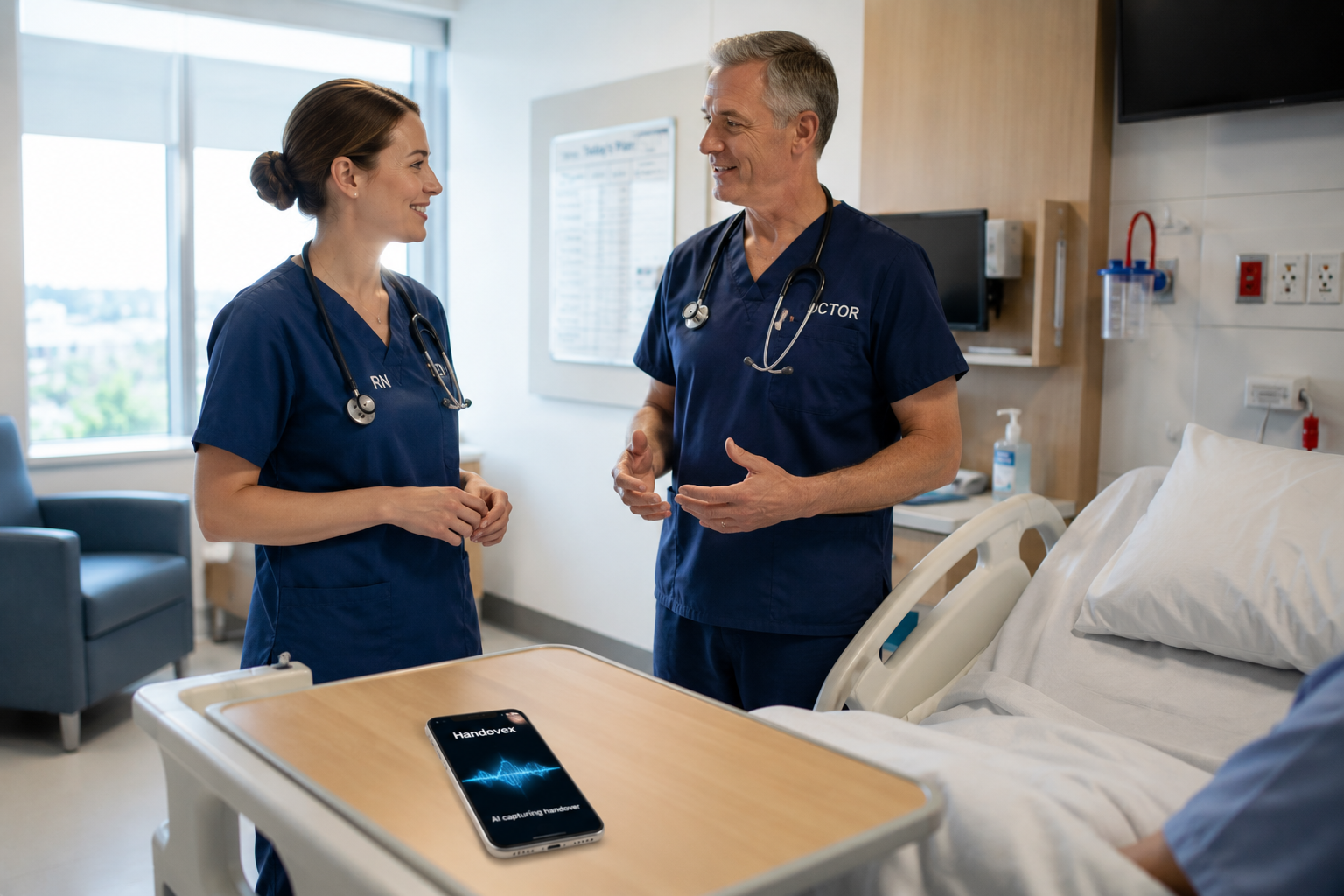
When integrated into a platform like Handovex, ambient voice capture changes the paradigm. Imagine two doctors standing at the bedside. They discuss the patient's deteriorating respiratory rate, the recent ABG results, and the plan to escalate to ICU if oxygen saturation drops further.
Instead of writing this down while trying to maintain eye contact, the Handovex ambient AI listens securely, extracting the exact vital signs, the clinical assessment, and the high-priority recommendations. By the time the doctors step away from the bed, a perfectly formatted ISBAR handover is ready for review and sign-off on their mobile device or EMR.
Implementing AI on the Ward: A Guide for Clinical Leads
If your hospital or health service is evaluating AI handover software, deployment strategy is just as important as the technology itself. Successful integration generally follows these three steps:
1. Target High-Friction Wards First: Don't roll it out everywhere at once. Start with high-turnover environments where the documentation burden is most acute, such as the Emergency Department (ED), General Medicine, or Intensive Care Units (ICU).
2. Prioritize EMR Integration: Clinicians will abandon tools that require double data entry. Ensure your ambient scribe can push structured text directly into your existing EMR (Cerner, Epic, or BOSSnet) via secure APIs.
3. Maintain the "Human in the Loop": AI does not replace clinical judgment. The golden rule of clinical documentation AI is that the clinician must always review, edit, and sign off on the generated note. The AI drafts the document; the doctor owns the clinical decision.
The Future is Hands-Free
The stethoscope was once the ultimate symbol of the medical profession. In the modern hospital, it has arguably been replaced by the keyboard.
By embracing ambient AI scribes, Australian hospitals have a rare opportunity to reverse this trend. Removing the barrier of the screen doesn't just make documentation faster—it brings the clinician back to the bedside, improving patient rapport, reducing clinical risk, and letting doctors be doctors again.
Are you ready to eliminate "pajama time" and secure your clinical handovers?
Request access today and see how our Australian-built, ISBAR-compliant ambient AI can automate your ward’s documentation in minutes.
Related posts
The Cost of Failing NSQHS Accreditation — Clinical, Financial, and Reputational
13 May 2026
Most Australian hospital executives focus on the survey itself. Few have fully mapped what non-compliance actually costs — before, during, and after the finding. This guide does exactly that, with dat
Why 80% of Serious Medical Errors Happen During Patient Handovers
8 May 2026
Every 8 hours, in hospitals across Australia, something quietly dangerous happens. Clinical teams change over. A night shift steps in for a day team. An ICU registrar hands their patients to a colleag
Related resources
Shareable guides and checklists for safer handovers.
ISBAR best practice
A practical structure for consistent clinical handovers.
Open →NSQHS Standard 6 handover checklist
A lightweight checklist for safer clinical communication.
Open →ISM alignment overview
Auditability, access control, and tenant isolation, at a high level.
Open →